
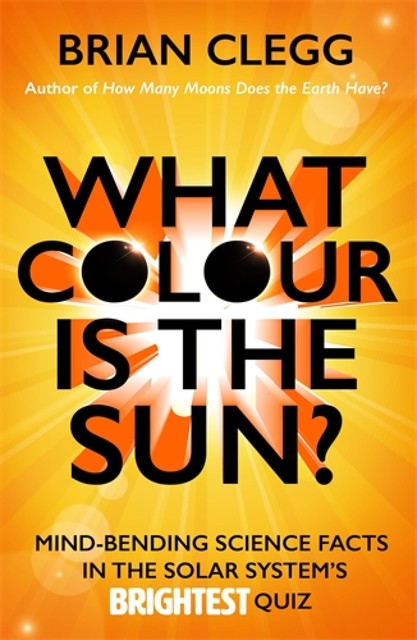
What Colour is the Sun
- Khen Sween Pangidézett8 évvel ezelőtt
 The wrinkles, it seems, are human tyre treads for hand grip and to make it less likely we will fall over on wet surfaces.
 - Mesutidézett8 évvel ezelőtt
 When a man sits with a pretty girl for an hour, it seems like a minute. But let him sit on a hot stove for a minute and it’s longer than any hour. That’s relativity.’
 - Mihai Madalina elenaidézett6 hónappal ezelőtt
 While you’re thinking …
Einstein published his definitive paper on general relativity (more correctly his general theory of relativity) in 1915.
While it’s possible to understand Einstein’s earlier special theory of relativity with high school mathematics, even the great man himself had to get help with the maths that would be required for general relativity.
The person who made the remark was, at the time, one of the most famous physicists in the world.
Arthur Eddington
There are a number of variants on the Eddington story. In the simple form used in the question, the questioner was said to be a newspaper reporter, while in a more sophisticated version, another physicist, Ludwik Silberstein, was said to have commented to Eddington that Eddington was one of the three who understood the theory. Silberstein, who clearly had himself and Einstein in mind for the other two, mistook Eddington’s delay in replying for modesty and told Eddington not be so shy, at which point Eddington is said to have replied cuttingly, ‘Oh, no. I was wondering who the third might be.’
There was no doubt that Eddington did understand the theory (though in reality there were plenty of others who did, including German mathematician David Hilbert, who, seeing an early version of Einstein’s ideas, nearly beat Einstein to the publication of a final version). Eddington also made considerable contributions to cosmology. But part of the reason he was so well known was because he was the Brian Cox of his day – he was an excellent science populariser.
It was also Eddington who helped cement Einstein’s victory by arranging an expedition to measure the light-bending effect predicted by general relativity during the solar eclipse of 1919. It has since been suggested that Eddington made sure the results supported Einstein’s theory, as his equipment and the conditions made it very difficult to come up with a definitive answer, but as far as the world was concerned, Eddington’s observations turned Einstein from a reasonably well-known theorist into a scientific superstar.
Further reading: Reality’s Frame - Mihai Madalina elenaidézett6 hónappal ezelőttElementary, my dear Aristotle
Name Aristotle’s five elements.
Answer overleaf
While you’re thinking …
Aristotle lived between 384 and 322 BC and was a pupil of Plato.
The idea of four elements dates back to Empedocles, born just over 100 years before Aristotle.
Aristotle is one of the many individuals to have been called ‘the first scientist’, though his philosophical methods were very different from those of a modern scientist.
Earth, air, fire, water and quintessence
All five required to get a point.
The four, more familiar, ancient elements date back further in Ancient Greek history and were based on reasonably logical, if incorrect, thinking. If you imagine, for instance, burning a piece of green wood, it gives off fire, watery sap oozes out of it, hot air and steam come off it, and you end up with ash. It seems to break down to those four elemental forms.
Much Ancient Greek physics was based on the idea that earth and water had gravity; their natural condition was to be as close to the centre of the universe as possible (i.e. close to the centre of the Earth), while air and fire had levity, with a tendency to move away from the centre of the universe.
Aristotle added the fifth element because he believed that everything below the Moon’s orbit was transient, but everything above it was eternal and unchanging. He felt that this perfect, immutable outer region needed its own special element that was not subject to levity or gravity, and it was simply named the ‘fifth element’ – the quintessence.
Because everything above the Moon’s orbit was expected to be unchanging (apart from the cyclical rotation of the heavenly spheres), Aristotle’s cosmology struggled with the likes of comets and new stars (what would become known as novas or supernovas). To fit his worldview these phenomena had to be sublunary – below the orbit of the Moon – which led to some mental contortions to explain how this could be possible.
Further reading: Reality’s Frame
QUESTION 8
A modest mind
Who, when asked if it was true that only three people in the world understood general relativity (including himself and Einstein), is said to have answered ‘Who is the third?’
Answer overleaf - Mihai Madalina elenaidézett6 hónappal ezelőttWhile you’re thinking …
Tetragonidzein were attempting to use geometry for a particular purpose. Geometry means ‘measuring the Earth’ in the original Greek.
Although the most famous geometric proof is called Pythagoras’ theorem, it was practical in use long before Pythagoras lived and there is no evidence that he developed the formal proof.
If you were taught traditional geometry at school, you would have ended a proof with Q.E.D., standing for quad erat demonstrandum, roughly ‘what was shown’. The original Greek version was ΟΕΔ, which stands for a Greek phrase that was approximately ‘the thing that was to be proved’.
Tetragonidzein were attempting to square the circle
Greek geometry existed in a strange detached world that had only a loose connection to reality. It was strongly influenced by ideas like that of Plato that there was an absolute archetype for an item like a triangle, and that what we saw in the world were just flawed versions, rather like shadows of an outside world cast on to the wall of a cave. The archetypal geometric objects were perfectly drawn in lines with zero width. And it had to be possible to construct a proof using only a small number of items – something like a pair of compasses, a straight edge and a perfect pencil to produce those zero-width lines.
Many challenges in geometric construction were overcome and were included in Euclid’s remarkable books on geometry, which started with a small number of ‘givens’ or ‘axioms’ and built a series of logical proofs. So robust was this system, because it was built on an abstract absolute rather than the real world, that Euclid’s books were still being used to teach geometry in the 20th century.
However, there were a number of apparently simple constructions and proofs that evaded the early geometers, so a lot of effort was put into attempting to complete them. One example was trisecting an angle – dividing it into three equal parts – and another was squaring the circle, which involved constructing a square with the same area as a given circle. Like the trisection this would eventually be proved impossible. We can see that easily now because we know that the area of the circle is dependent on pi, a transcendental number – one that never settles down to a repeating pattern, which makes it impossible for a simple construction technique to reproduce the area exactly.
Further reading: Are Numbers Real?
QUESTION 7 - Mihai Madalina elenaidézett6 hónappal ezelőttWhile you’re thinking …
Isaac Newton had a very large library for the time with around 2,100 titles.
After remaining pretty much in one piece through to the 20th century, much of Newton’s library was auctioned off in the 1920s.
To put the size of Newton’s library into context, his Cambridge college at the time, Trinity, which had one of the better libraries, owned between 3,000 and 4,000 books.
Theology
You might expect that physics would be Isaac Newton’s number one reading subject, but with 109 titles it only came in fifth place, after theology (477), fiction (207), alchemy (138) and mathematics (126), though admittedly the dividing line between physics and maths was not the same then as it is now – Newton’s own masterpiece of physics, The Principia, was classified in his library under mathematics.
The large numbers of alchemy and theology books should be no great surprise, as Newton probably spent more time on these subjects than he did on science. Although not a conventional Anglican, he had strong Christian beliefs and spent a lot of time on theology and on detailed analysis of the Bible (working out, for instance, when he expected Christ’s second coming to occur). Similarly, alchemy, which at the time had not entirely separated from chemistry, was a field in which he probably experimented more than he did in physics, though this activity was kept quiet, as alchemy was considered a little too close to magic to be respectable. Alchemy was divided into two, with some, like the early chemist Robert Boyle, concentrating primarily on speculative alchemy, which was closer to chemistry in studying how elements combined. But Newton seems to have been more interested in operative alchemy, which included the attempt to transmute base metals into gold.
Asked to think of categories included in Newton’s library, it is easy to overlook those fiction titles because Newton is always portrayed as intensely serious and single-minded, but clearly he enjoyed fiction. Other subjects covered included economics and medals, reflecting his time at the Royal Mint.
Further reading: The Library of Isaac Newton
QUESTION 6
Greek gyrations
The Ancient Greeks had a word for people who attempted a geometric feat we now know to be impossible: τετραγονιδζειν (tetragonidzein). What were those people trying to do? - Mihai Madalina elenaidézett6 hónappal ezelőttletters (γ′ = ⅓, δ′ = ¼ …). So what was β′?
Answer overleaf
While you’re thinking …
To confuse things more, the Ancient Greeks used a couple of obsolete letters – such as the digamma, which had been dropped from the alphabet – to represent numbers.
The biggest number in the basic Greek system was a myriad (10,000), though a myriad myriads (100 million) was sometimes used.
The letter-based approach wasn’t the only number system used by the Greeks, who started with more of a tally-based system. Letters are often still used in Greek for ordinal numbers – the numbers based on order, such as the third item in a list.
Two-thirds
Bizarrely, while almost any number with a dash was 1/that number, β′ was ⅔. The Ancient Greeks used a special character for ½, which looked like a zig-zag lightning bolt: .
Even more so than the more familiar Roman numbering system, the Greek system did not make arithmetic easy. It was bad enough adding two numbers when each number was represented by a different letter, but was even more complicated with fractions. Unable to apply the kind of top and bottom logic we use in handling fractions, the Greeks had to resort to published tables that contained the results of the tedious construction of different calculations.
It also didn’t help that the Greeks weren’t really thinking of fractions in the same way that we do. All their ‘fractions’ had 1 on the top. To get what we would call ⅗, for instance, they would have to use three lots of ⅕. This reflects that a quantity like γ′ was not seen as one-third, but as the third part. That sounds like simply a distinction of wording, but it’s not. Rather than thinking of a whole number divided by three (hence a fraction), the Greeks were thinking of a whole number, three of which would make a bigger whole. It was a very visual approach, like thinking of three small stones making up a bigger stone. The mathematics works, but there are no fractional stones – they are all whole stones – and the Greek ‘fractions’ were conceptually whole numbers.
Further reading: A Brief History of Infinity
QUESTION 5
Isaac’s tomes
On which subject did Newton own the most books?
Answer overlea - Mihai Madalina elenaidézett6 hónappal ezelőttWhat is the unit of measure the cubit based on?
Answer overleaf
While you’re thinking …
Units of measurement are often based on a natural quantity or size.
The kilogram was originally defined as the weight of a cubic decimetre of distilled water at the temperature of melting ice, though for practical purposes, chunks of a platinum-iridium alloy of this mass were used as reference kilograms.
Perhaps the most obvious natural unit of measurement is the foot, though few individuals have a foot that is as long as a modern foot length, which is roughly the equivalent of a UK shoe size 13 (US size 14, EU size 47).
The distance from the elbow to the tip of the middle finger
The cubit is a common mid-range measure from ancient times. By using a part of the body as the standard, the cubit was easy to measure out without the need for any equipment. There are other body-based measures in the traditional system, though all were thrown away with the move to metric. So, for example, although the English word ‘inch’ comes from the Latin for one-twelfth, in many languages it corresponds to the word for thumb, as it was originally approximately the width of an adult male’s thumb.
The cubit was renamed the ell in medieval times and was widely used in Europe as a measurement of cloth, for obvious reasons, as the arm could be used as an easy measure.
The trouble with all such person-based measures is that people come in a range of shapes and sizes. This makes the measures fine for approximate concepts, such as spacing out crops, but not when selling a product or doing mathematics, where a standard tends to be introduced.
Even when there was a standard, though – the ell, for example, was measured in England using something known as the ell-wand – that standard tended to vary from place to place, leading to potential confusion. So, for example, Archimedes, in his book The Sand Reckoner, makes an estimate of the size of the universe measured in stades – the distance around a Greek running track. But there was no fixed length for this: stades differed from city to city; so we aren’t sure exactly what distance he had in mind.
Further reading: Measure for Measure
QUESTION 4
Adding with letters
In Greek maths, the numbers were represented by letters (α = 1, β = 2, γ = 3 …) and fractions were represented by dashed let - Mihai Madalina elenaidézett6 hónappal ezelőttFurther reading: The Quantum Age
QUESTION 2
What’s in a name?
Where did the German natural philosopher Regiomontanus come from? (The clue’s in the name.)
Answer overleaf
While you’re thinking …
Some of the names by which the early scientists and philosophers are known are really Latinised versions of their name, or even of nicknames.
Some scientific nicknames referred to personal qualities, or to where the individual originated.
An example of a straightforward Latinised name would be the man who devised the biological naming system still used, Linnaeus, whose actual name was Carl von Linné, while the mathematician Tartaglia was actually called Niccolò Fontana, with Tartaglia being a nickname based on his stammering.
Regiomontanus came from Königsberg
It helps to know a little German to see how Johannes Müller could end up better known as Regiomontanus. The 15th-century mathematician and astronomer was born near Königsberg in what is now Bavaria. The name of the German town simply means King’s Mountain – if there were an English equivalent, it would be something like Mountroy. And a Latinised version of King’s Mountain would be Regiomontanus.
The tendency to give these Latin epithet names had some apparent similarities to the medieval tendency to use scholastic accolades, although the reason for doing so was rather different. Scholastic accolades were honorary titles, applied to theologians and other academics to imply that they were the outstanding scholars of their day. So, for instance, Thomas Aquinas was Doctor Angelicus and Roger Bacon was Doctor Mirabilis.
As almost all academic writing was in Latin all the way through to the 1600s – Isaac Newton, for instance, wrote his key work, The Principia, in Latin, though Galileo had already bucked the trend a few decades earlier by writing his books in Italian – it was common to use Latinised versions of names, which were usually simply achieved by sticking a Latin ending on to the surname, but occasionally, as with Regiomontanus, involved a more convoluted Latin equivalent to a nickname or birthplace.
Further reading: The Quantum Age
QUESTION 3
No half measures - Mihai Madalina elenaidézett6 hónappal ezelőttQUIZ 1
ROUND 2: HISTORY OF SCIENCE
QUESTION 1
Walking the Planck
What subject did physicist Max Planck’s physics professor advise him to study at university?
Answer overleaf
While you’re thinking …
Max Planck was born in Kiel, Germany, in 1858.
The professor in question was Philipp von Jolly, based at the University of Munich.
Max Planck would go on to take the essential theoretical step that precipitated the transformation of physics by quantum theory.
Music
When the young Max Planck was exploring his options for university, he could, in principle, have chosen physics or music. While he had been both interested in physics and good at the subject, along with the underlying mathematics, he was also an excellent musician, playing the piano to concert standard. Planck genuinely could have opted for a career in music, and the physics professor, Philipp von Jolly, tried to persuade the young student that there really was not a lot of point in going with physics.
According to von Jolly, physics was pretty well finished as a discipline. He pointed out that apart from a few small gaps, almost everything that needed to be discovered already had been. It seemed that von Jolly was suggesting that there was no opportunity for Planck to cover himself in glory by discovering something new and exciting. However, von Jolly reckoned without Planck’s modesty. The student said that he was not particularly interested in discovering new things, simply wishing to understand the existing physical theories.
We don’t know how Planck would have turned out as a musician, but in physics he ended up outshining von Jolly and becoming such a name in German science that when it was considered politic to rename the society responsible for German science research from the Kaiser Wilhelm Society, it became the Max Planck Society, with the associated Institutes, now numbering over 80, known as the Max Planck Institutes.
It is ironic that, while von Jolly indeed did not add much that was new to the constituents of physics, Planck would help found quantum theory, one of two new areas of physics (the other being relativity) that blew apart von Jolly’s comfortable picture of a near-complete knowledge of the subject.
fb2epub
Húzza és ejtse ide a fájljait
(egyszerre maximum 5-öt)